



Full HD (FHD) remains an excellent choice for the vast majority of daily users, balancing visual quality with affordability and performance. It provides crisp images for productivity, immersive entertainment, and doesn’t demand high-end hardware, making it a highly practical and budget-friendly option. While higher resolutions exist, FHD offers a sweet spot that satisfies most needs without significant compromise.
Is FHD Good for Daily Use?
In a world increasingly obsessed with 4K, 8K, and beyond, it’s easy to feel like anything less than the absolute cutting edge is somehow “outdated.” You might be wondering if your Full HD (FHD) monitor or laptop screen is still cutting it for your daily needs. Let’s be real: most of us aren’t professional video editors or hardcore competitive gamers. For the average person, the question isn’t about having the absolute best resolution, but rather “Is FHD good for *my* daily use?”
The short answer for most people is a resounding “Yes!” Full HD, often referred to as 1080p, has been the standard for a long time, and for good reason. It strikes an incredible balance between visual quality, performance, and affordability. It delivers clear, vibrant images without demanding top-tier hardware, making it an incredibly practical and reliable choice for a vast range of everyday activities. But let’s dive deeper into why FHD continues to be a powerhouse for daily tasks.
So, if you’re trying to decide on a new monitor, upgrading your laptop, or just want to feel confident in your current setup, stick around. We’re going to break down everything you need to know about FHD for work, play, and everything in between. You might just find that what you already have, or what you’re considering, is perfectly suited for your digital life.
Key Takeaways
- FHD is the Gold Standard: Full HD (1920×1080) is still the most prevalent and widely supported resolution across various devices and content, making it highly compatible for everyday use.
- Excellent for Productivity: For tasks like web browsing, document editing, email, and video calls, FHD provides perfectly crisp text and sufficient screen real estate for comfortable, extended use.
- Great for Entertainment: Streaming movies, TV shows, and playing casual or even many mainstream games look fantastic on an FHD display, especially for screen sizes up to 27 inches.
- Highly Cost-Effective: FHD monitors and laptops are significantly more affordable than their QHD or 4K counterparts, offering exceptional value without sacrificing core functionality.
- Lower Hardware Demands: Running applications and games in FHD requires less processing power from your computer’s CPU and GPU, potentially leading to smoother performance and longer battery life for laptops.
- Optimal for Most Screen Sizes: Up to approximately 27 inches, FHD offers a pixel density that is more than adequate for a sharp, clear viewing experience at typical viewing distances.
- Consider Alternatives for Specific Needs: While FHD is excellent for general use, professional creative work (graphic design, video editing) or competitive gaming on larger screens might benefit from higher resolutions.
Quick Answers to Common Questions
Is FHD better than HD?
Yes, FHD (1920×1080) is significantly better than standard HD (1280×720) in terms of pixel count and image clarity. FHD offers more than twice the pixels, resulting in sharper images and more screen real estate.
Can you watch 4K content on an FHD screen?
Yes, you can watch 4K content on an FHD screen, but it will be downscaled to 1080p. While it won’t display in true 4K resolution, it will often still look better than native 1080p content due to the higher source quality.
Is FHD good for gaming?
FHD is excellent for gaming, especially for casual and mainstream titles. It allows for higher frame rates with less demanding hardware compared to QHD or 4K, providing a smooth and responsive gaming experience for most players.
Does FHD save battery life on laptops?
Yes, FHD screens generally consume less power than QHD or 4K screens on laptops. This means laptops with FHD displays typically offer better battery life, which is a significant advantage for portability.
Is FHD still relevant in 2024?
Absolutely, FHD is still highly relevant in 2024. It remains the most common and practical resolution for everyday computing, offering an optimal balance of cost, performance, and visual quality for the vast majority of users.
📑 Table of Contents
Understanding FHD: What Exactly Is It?
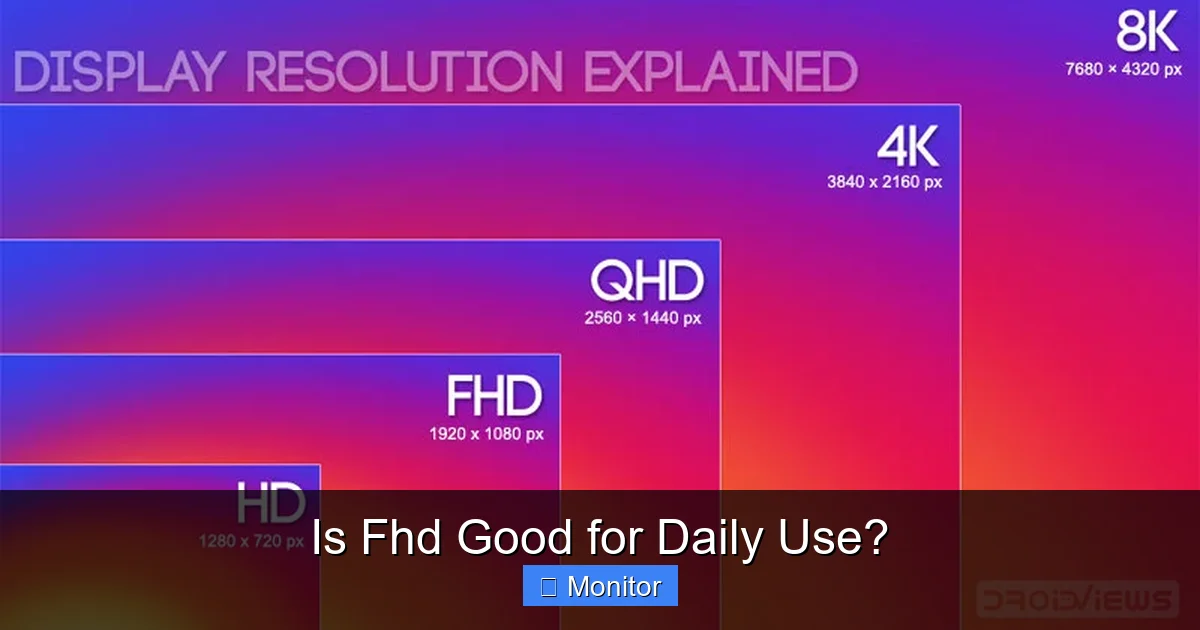
Before we dive into its daily applications, let’s quickly clarify what FHD actually means. FHD stands for Full High Definition, and it refers to a display resolution of 1920 pixels wide by 1080 pixels high. This means there are just over 2 million individual pixels on the screen, working together to create your image.
The Pixel Power Behind FHD
Think of pixels as tiny building blocks. The more blocks you have packed into a given space, the finer the detail and the smoother the curves and lines appear. For years, FHD replaced standard HD (720p, or 1280×720 pixels), offering a significant jump in clarity and detail. Today, it sits below Quad HD (QHD or 1440p) and Ultra HD (4K or 2160p) in terms of pixel count, but that doesn’t make it any less capable for general daily usage. For a monitor around 24-27 inches, FHD provides an excellent pixel density, meaning the pixels are small enough that you typically won’t see individual ones at a normal viewing distance. This results in a crisp and pleasant viewing experience.
FHD for Everyday Productivity: Work and Study
Visual guide about Is Fhd Good for Daily Use?
Image source: cdn.shortpixel.ai
When it comes to getting things done, an FHD display is more than just “good”—it’s often ideal. Most office applications, web browsers, and communication tools are designed with FHD in mind, ensuring a seamless experience.
Crisp Text and Comfortable Reading
For tasks like writing documents in Word, crunching numbers in Excel, or managing emails, clear text is paramount. FHD provides excellent text clarity. Letters and numbers appear sharp and easy to read, reducing eye strain even during long work sessions. Imagine reading an e-book or a lengthy report; the text on an FHD screen is perfectly defined, making continuous reading comfortable. This is a crucial aspect for students and professionals spending hours looking at documents and web pages.
Web Browsing and Multimedia Consumption
The internet is primarily consumed in FHD. Most websites are optimized to display beautifully at 1920×1080. News articles, blogs, online shopping, and social media feeds all render perfectly, without requiring your computer to downscale or upscale content, which can sometimes lead to blurriness. Video conferencing tools like Zoom or Microsoft Teams also look great on FHD. Colleagues and friends appear clear, and screen sharing works flawlessly without any resolution headaches. For general web browsing, an FHD monitor or laptop offers a fantastic, unobstructed view of the digital world.
Multitasking on FHD
While higher resolutions offer more “screen real estate,” FHD is perfectly adequate for many multitasking scenarios. You can comfortably place two document windows side-by-side, or have a browser window open next to your email client. Modern operating systems offer robust window snapping features that make managing your workspace efficient on an FHD display. For example, having a research paper open on one half of your screen and a word processor on the other is a breeze. For the average user, the benefits of more pixels often come with trade-offs in cost and performance that aren’t always justified for these common productivity needs.
Entertainment on an FHD Screen: Movies, Shows, and Casual Gaming

Visual guide about Is Fhd Good for Daily Use?
Image source: m.media-amazon.com
When it’s time to kick back and relax, your FHD screen is ready to deliver. From streaming the latest blockbusters to enjoying your favorite games, FHD handles entertainment with impressive fidelity.
Immersive Streaming Experience
Think about your favorite streaming services: Netflix, YouTube, Disney+, Hulu, Amazon Prime Video. A huge percentage of their content is streamed in FHD. Many movies and TV shows are produced and distributed in 1080p, meaning an FHD screen will display them exactly as intended. You’ll get rich colors, good contrast, and sharp details. Watching a high-quality FHD video on an FHD monitor is a truly immersive experience that many people find indistinguishable from higher resolutions unless they are sitting unusually close to a very large screen. Plus, streaming in FHD requires less bandwidth than 4K, which can be a real benefit if your internet connection isn’t always top-tier.
Casual and Mainstream Gaming
For gamers, the question “Is FHD good for daily use?” is often about performance vs. visual fidelity. An FHD monitor is a fantastic choice for a wide variety of games.
- Better Performance: Running games at FHD (1080p) requires significantly less graphical processing power than running them at QHD or 4K. This means you can achieve higher frame rates (FPS) with a more affordable graphics card, leading to smoother gameplay.
- Wider Compatibility: Most games are optimized to run well at FHD. Even competitive esports titles like League of Legends, Valorant, or CS:GO are often played by professionals at FHD for maximum frame rates and responsiveness.
- Great Visuals: While not 4K, modern games still look stunning at FHD, especially with anti-aliasing and other graphical settings cranked up. The level of detail and immersion is more than sufficient for most players.
Unless you are a professional esports player requiring 240+ FPS or a visual enthusiast seeking the absolute peak of graphical realism at 4K, an FHD screen paired with a mid-range graphics card offers an exceptional and highly enjoyable gaming experience.
The Cost-Effectiveness and Accessibility of FHD

Visual guide about Is Fhd Good for Daily Use?
Image source: assets-global.website-files.com
One of the most compelling arguments for FHD is its sheer value. In a world where tech budgets are always a consideration, FHD shines as the smart choice.
Affordable Hardware
FHD monitors, laptops, and even TVs are significantly more affordable than their higher-resolution counterparts. This accessibility means you can get a great quality display without breaking the bank. For example, a high-refresh-rate FHD gaming monitor might cost less than a basic QHD monitor, offering a better overall experience for gaming within a budget. This cost-effectiveness extends to the components inside your computer as well. A graphics card capable of running games smoothly at FHD is much cheaper than one needed for QHD or 4K.
Lower Demands on Your System
Because FHD has fewer pixels than QHD or 4K, your computer’s CPU and GPU have less work to do.
- Smoother Performance: This translates to faster loading times, smoother multitasking, and better overall responsiveness of your operating system and applications.
- Improved Laptop Battery Life: For laptops, displaying fewer pixels consumes less power. This means an FHD laptop screen will generally give you better battery life compared to a QHD or 4K equivalent, a crucial factor for productivity on the go.
- Reduced Heat and Noise: Less work for your components also means less heat generation and often quieter operation, especially for laptops and desktop PCs under load.
This combination of affordability and efficiency makes FHD an incredibly practical choice for daily use, especially for students, home office workers, and casual users who want a solid experience without overspending.
When Might You Need More Than FHD?
While FHD is fantastic for most users, there are specific scenarios where stepping up to QHD or 4K might be beneficial. It’s important to understand these cases to make an informed decision.
Professional Creative Work
If your daily use involves professional-level creative tasks, higher resolutions can offer a significant advantage.
- Graphic Design: For graphic designers, having more pixels means being able to see finer details in images without zooming in constantly. This precision is invaluable for tasks like photo editing, digital painting, and intricate vector work.
- Video Editing: Video editors working with 4K footage will find a 4K monitor essential for previewing their work at its native resolution, ensuring accuracy and detail during the editing process. QHD can still be a good compromise.
- CAD and 3D Modeling: Engineers and 3D artists benefit from the extra screen real estate and detail that higher resolutions provide, allowing them to view complex models with greater clarity and less panning/zooming.
In these fields, the investment in a higher-resolution display directly impacts workflow efficiency and the quality of output.
Large Screen Sizes and Competitive Gaming
The impact of resolution also heavily depends on screen size and viewing distance.
- Very Large Monitors (27+ inches): On monitors larger than 27 inches, especially at typical desktop viewing distances, FHD pixels can start to appear noticeable (“pixelated”). Here, QHD or 4K can provide a much sharper image, making text and images smoother. For example, a 32-inch FHD monitor would likely look less crisp than a 27-inch FHD monitor.
- High-End Competitive Gaming: While many esports pros play at FHD for frame rates, some competitive gamers who prioritize maximum clarity on larger screens, or who have top-tier graphics cards, might opt for QHD or 4K to gain a slight edge in spotting distant enemies or enjoying more detailed environments.
- Multiple Monitors: If you’re running a multi-monitor setup and want consistent high detail across all screens, matching resolutions might be a consideration, though mixing FHD with higher resolutions is perfectly viable for most.
Ultimately, if you have very specific visual demands, a keen eye for detail, or work with content that directly benefits from increased pixel density, a jump to QHD or 4K might be worth the extra cost and hardware requirements.
The Verdict: Is FHD Good for Your Daily Use?
So, after all this discussion, is FHD good for daily use? For the vast majority of people, the answer is an enthusiastic and confident “Yes!” FHD continues to be a phenomenal resolution that delivers clear, vibrant visuals for almost every everyday task.
If you’re using your computer for:
- Web browsing, email, and social media
- Word processing, spreadsheets, and presentations
- Streaming movies and TV shows from Netflix, YouTube, etc.
- Casual gaming or even many mainstream titles
- Video calls with friends, family, or colleagues
- General photo viewing and light photo editing
Then an FHD display will serve you incredibly well. You’ll get excellent visual quality, strong performance, and outstanding value for your money. It’s the practical, smart choice that often outperforms its higher-resolution cousins in terms of affordability and efficiency for daily needs.
While 4K and QHD offer more pixels, the benefits for general use are often marginal compared to the increased cost, higher hardware demands, and potential impact on battery life. Unless you have specific professional needs like high-end graphic design or are a hardcore competitive gamer with a premium budget, sticking with FHD is a perfectly intelligent and satisfying decision. Embrace your FHD screen; it’s a workhorse that consistently delivers a great experience every single day.
Frequently Asked Questions
What is the difference between FHD and 1080p?
There is no difference; FHD (Full High Definition) is simply another term for 1080p. Both refer to a display resolution of 1920 pixels wide by 1080 pixels high, making them interchangeable terms in common usage.
Is FHD clear enough for office work?
Yes, FHD is more than clear enough for office work. Text is crisp, images are sharp, and there’s sufficient screen space for documents, spreadsheets, and web browsing, ensuring comfortable and productive daily use.
Do I need a powerful graphics card for FHD gaming?
No, you don’t need a top-tier powerful graphics card for FHD gaming. A mid-range GPU is often sufficient to achieve excellent frame rates at 1080p, making it a very accessible and budget-friendly option for gamers.
How does screen size affect FHD quality?
Screen size significantly affects perceived FHD quality. On smaller screens (e.g., 22-24 inches), FHD looks incredibly sharp. As the screen size increases beyond 27 inches, individual pixels might become more noticeable at typical viewing distances, potentially making higher resolutions more appealing for larger displays.
Is FHD good for watching movies on a monitor?
Yes, FHD is very good for watching movies on a monitor. Most streaming services offer a vast library of content in 1080p, which looks fantastic on an FHD display, providing an immersive and satisfying cinematic experience.
When should I consider a resolution higher than FHD?
You should consider a resolution higher than FHD if you’re a professional graphic designer or video editor, a competitive gamer on a very large monitor (27+ inches), or if you simply prioritize the absolute sharpest image and have the budget for more expensive hardware.



