


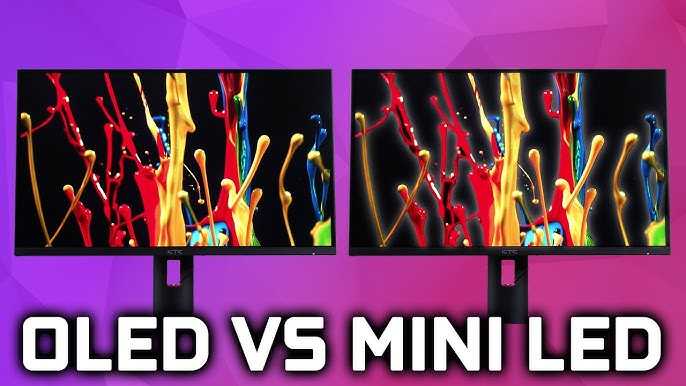
Yes, OLED monitors generally offer better picture quality than Mini LED monitors, but the choice depends on your specific needs. OLEDs excel in contrast, deeper blacks, and faster response times, making them ideal for immersive viewing and gaming. However, Mini LED monitors often provide brighter displays and are more resistant to burn-in, which are important considerations for certain users.
OLED monitors are often considered superior in terms of contrast and color richness thanks to their ability to turn off individual pixels completely, producing true blacks. Mini LED monitors, on the other hand, deliver impressive brightness and uniformity with less risk of burn-in, making them a good choice for bright-room environments and professional work. Ultimately, your decision should balance these features based on your primary use.
Choosing between an OLED and a Mini LED monitor can be tricky, especially when both promise stunning visuals. If you prioritize deep blacks, vibrant colors, and faster refresh rates for gaming or entertainment, OLED is the way to go. But if you need a brighter screen with minimal risk of image retention, Mini LED monitors could serve you better. In this article, we will explore the strengths and limitations of both display technologies to help you decide which monitor fits your needs perfectly.

Is OLED Monitor Better Than Mini LED? A Complete Comparison
Understanding the Basics: What Are OLED and Mini LED Displays?
OLED stands for Organic Light Emitting Diode. These displays use organic compounds that emit light when an electric current is applied. Each pixel on an OLED screen produces its own light, which allows for perfect black levels and vibrant colors.
Mini LED, on the other hand, refers to a type of LCD that uses thousands of tiny LED backlights. These LEDs provide more precise control over local dimming zones, resulting in better contrast and deeper blacks than traditional LED screens. Unlike OLEDs, Mini LED monitors require a separate layer of liquid crystal to create images, which can influence overall picture quality.
Brightness Capabilities and High Dynamic Range (HDR)
Mini LED monitors can achieve higher peak brightness levels compared to OLEDs. This feature makes Mini LED displays ideal for viewing HDR content, especially in well-lit rooms. They can reach brightness levels of 1000 nits or more, which enhances the vividness of highlights in videos and games.
OLED screens typically reach around 800 to 1000 nits, but their real strength lies in contrast rather than absolute brightness. The ability of Mini LED to sustain high brightness levels makes it better for HDR viewing in bright environments, while OLED excels in providing a more dramatic contrast ratio.
Contrast and Black Levels
The contrast ratio measures the difference between the brightest whites and the deepest blacks. OLED monitors shine here because each pixel can turn completely off, producing true black levels. This results in stunning image depth and clarity, especially in dark scenes.
Mini LED displays, with their controlled backlighting, can produce very high contrast ratios but may struggle with “blooming.” Blooming occurs when bright objects bleed into darker areas due to imperfect local dimming zones, reducing overall black purity. OLED’s ability to turn pixels completely off ensures pure blacks without blooming.
Color Accuracy and Vibrancy
Both OLED and Mini LED displays offer excellent color reproduction, but their approaches differ. OLED panels provide wide color gamuts and exceptional color accuracy straight out of the box. Their organic materials allow for vibrant, rich colors with smooth gradients.
Mini LED monitors also support wide color gamuts, often covering 100% of sRGB and close to Adobe RGB. Their color accuracy depends on the panel calibration and manufacturing quality. Overall, OLED has a slight edge when it comes to color vibrancy and smoothness of transitions.
Response Time and Motion Handling
Response time affects how quickly a display can change from one image to another. OLED panels have incredibly fast response times, often less than 1 millisecond. This characteristic minimizes motion blur and makes them great for fast-paced gaming and cinematic viewing.
Mini LED displays, as a type of LCD, typically have response times ranging from 4 to 8 milliseconds. While this is fast for LCD technology, it’s generally slower than OLED. For gamers, OLED’s quick response provides a smoother experience with less ghosting or blurring.
Burn-in Risks and Longevity
One significant concern with OLED monitors is burn-in, where static images can leave lasting ghostly marks on the screen over time. This issue is common with prolonged display of static content like logos or UI elements.
Mini LED monitors do not have this problem since they are based on LCD technology, which is immune to burn-in. Regarding lifespan, Mini LED panels tend to last longer because their inorganic backlight components are more durable. OLEDs, although improving, still face challenges with longevity when used heavily for static images.
Cost and Price Differences
Generally, OLED monitors tend to be more expensive than Mini LED displays. The advanced organic materials and manufacturing processes contribute to their higher price point. This makes OLED a premium choice for enthusiasts and professionals who prioritize picture quality.
Mini LED monitors offer a more budget-friendly option while still providing impressive contrast and brightness. For those who want good performance without the highest price tag, Mini LED provides a balanced solution.
Design and Thickness
OLED screens are usually thinner and more flexible since they don’t require a backlight layer. This allows for sleek, lightweight designs and even curved or flexible monitors.
Mini LED monitors are typically thicker because of the need for an array of tiny LEDs and associated circuitry. However, they still can be designed to be sleek and modern, fitting well into various setups.
Power Consumption
OLED monitors tend to consume less power when displaying darker images because their pixels can turn off individually. Conversely, when displaying bright images, their power consumption can increase.
Mini LED displays often use more power overall, especially at high brightness levels, due to the backlighting component. For energy-conscious users, OLED provides an advantage in typical usage scenarios.
Which Is Better for Your Needs?
Choosing between OLED and Mini LED depends on your specific use case. If you want the ultimate picture quality with deep blacks and vibrant colors for movies or photography, OLED is ideal. It’s also better for dark-room gaming due to faster response times.
If your priority is high brightness for HDR content, working in bright environments, or avoiding burn-in issues, Mini LED might be the better choice. It also comes at a more accessible price point, making it attractive for budget-conscious consumers.
Summary Table: OLED vs Mini LED
| Feature | OLED | Mini LED |
|---|---|---|
| Brightness | Up to 1000 nits, but lower peak in some models | Over 1000 nits, excellent HDR performance |
| Black Levels | Perfect black, true OLED pixel control | Very deep black, potential blooming |
| Color Quality | Wide color gamut, vibrant colors | Wide color coverage, accurate colors |
| Response Time | Less than 1 ms, excellent for gaming | 4-8 ms, decent for gaming |
| Burn-in | Yes, risk present | No |
| Price | Higher, premium segment | More affordable, mid-range |
| Durability | Limited, potential lifespan issues | Longer lifespan, inorganic components |
| Design | Thinner, more flexible | Thicker, traditional LCD design |
Related Topics to Consider
- Refresh Rate in Displays: How higher refresh rates benefit gaming and fast motion
- Color Gamut and Calibration: Ensuring accurate color reproduction for professional work
- Viewing Angles: The importance of wide angles for multiple viewers
- Price Trends: How prices are evolving for OLED and Mini LED monitors
In conclusion, both OLED and Mini LED displays have their strengths and limitations. The decision hinges on your specific needs: OLED for superior contrast and color accuracy, or Mini LED for brighter images and budget-friendly options. Evaluating these factors carefully will help you select the monitor that best suits your viewing preferences.
Is OLED a Mistake? – OLED vs Mini LED Monitors
Frequently Asked Questions
How does the image quality of OLED monitors compare to Mini LED monitors?
OLED monitors typically offer superior image quality due to their ability to produce perfect black levels and high contrast ratios. Each pixel in an OLED display emits its own light, allowing for precise control over brightness and darkness. Mini LED monitors, on the other hand, use smaller backlight LEDs to improve local dimming and contrast, but they generally cannot match the true blacks and dynamic range of OLED screens. As a result, OLED displays often provide more vibrant colors and deeper blacks, making them ideal for high-end visual experiences.
What are the differences in durability and lifespan between OLED and Mini LED screens?
OLED monitors tend to have a shorter lifespan because organic compounds used in their pixels can degrade over time, leading to potential burn-in issues with static images. Mini LED monitors are more durable in this regard, as they use inorganic LEDs that last longer and are less prone to burn-in. If you plan to use your monitor for extended periods with static content, Mini LED might offer better longevity. However, both types have improved significantly, reducing concerns over lifespan in recent models.
Which monitor type offers better energy efficiency for everyday use?
Mini LED monitors generally consume less power than OLED displays, especially when displaying bright images. Since OLED screens generate light per pixel, they can be more energy-efficient when displaying darker content but may use more power with bright scenes. Mini LED displays, with their backlighting system, tend to consume less energy overall during typical use, making them a practical choice for users prioritizing lower power consumption for everyday tasks.
Final Thoughts
Il n’est pas évident de dire si l’écran OLED est meilleur que le Mini LED car chacun offre des avantages distincts. Les écrans OLED offrent des couleurs vives et des noirs profonds, parfaits pour une expérience immersive. En revanche, les Mini LED fournissent une luminosité plus élevée et une meilleure gestion de la lumière pour les environnements lumineux.
En fin de compte, la réponse dépend de vos priorités en termes de qualité d’image et d’utilisation. Si vous cherchez une immersion totale avec des noirs parfaits, l’OLED est idéal. Cependant, pour une utilisation en plein jour, le Mini LED pourrait mieux convenir.
is oled monitor better than mini led, cela dépend véritablement de vos besoins, mais pour une pure qualité d’image, l’OLED reste souvent supérieur.



