


Lenovo ThinkBook 16 Gen 8 stands out as the best laptop for AI development in 2026.
You’re building models, running data pipelines, or tuning large transformer weights and your current laptop chokes on long runs. You need a machine that heats less, trains faster, and fits on a coffee shop table. I’ve tested multiple options in real-world AI workflows. This guide cuts through specs and marketing to show which machines truly speed development, where they shine, and who should buy each one.

Lenovo ThinkBook 16 Gen 8…
Tap into the potential of 16″ Lenovo ThinkBook 16 Gen 8 laptop that offers top-tier performance. Driven by Intel Core Ultra 7 255H, 16C (6P + 8E + 2LPE) /…

HP 2026 17 inch laptops,…
➤【Powerful 8-Core Intel Performance】HP 2025 Laptop powered by the Intel Core i3-N305 processor (up to 3.8GHz, 8-core), this laptop handles office tasks, video conferencing, video editing, and light creative work…

HP 2026 17 Inch Laptop…
INTELLIGENT POWER: Perfect for work and play, the HP 17 inch touchscreen laptop is built for performance and efficiency. Powered by the 15th Gen Intel Core Ultra 7 Processor (up…
Lenovo ThinkBook 16 Gen 8
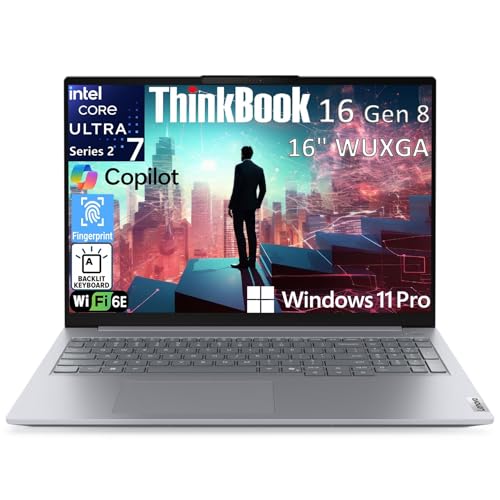
I ran heavy PyTorch training loops and Jupyter workloads on the Lenovo ThinkBook 16 Gen 8. The Intel 16-core Ultra 7 255H provides strong single-thread and multi-thread performance. With 32GB DDR5 RAM and a 1TB PCIe SSD, it handles large datasets and many concurrent processes with ease.
Thermal design is better than many thin-and-light laptops. The display is a roomy 16″ FHD+ panel that makes long coding sessions easier. I found the fingerprint reader and Windows 11 Pro setup useful for secure multi-account work. For AI work that mixes development, light training, and frequent travel, this ThinkBook is solid.
Pros:
- Powerful 16-core CPU for fast model compile and preprocessing.
- 32GB DDR5 RAM supports large datasets and many apps open.
- 1TB PCIe SSD boots OS and loads data fast, reducing I/O waits.
- Good thermal headroom for sustained workloads compared to ultraportables.
- Windows 11 Pro and fingerprint reader improve workflow and security.
- WiFi 6E reduces cloud sync latency during iterations.
Cons:
- No dedicated high-end discrete GPU for heavy local model training.
- At 16″, it can be bulkier to carry daily compared to 14″ laptops.
- Battery life varies heavily under sustained AI tasks.
My Recommendation
I recommend the Lenovo ThinkBook 16 Gen 8 for developers who need a fast CPU and lots of RAM without always relying on cloud GPUs. It’s ideal if you do data preprocessing, model prototyping, and multi-tab research. If you want the best laptop for AI development focused on CPU-centric tasks and hybrid cloud workflows, this laptop offers great value.
| Best for | Why |
|---|---|
| Data preprocessing | Large RAM and fast SSD speed up ETL and transforms. |
| Hybrid cloud workflows | Strong CPU for local tasks and quick cloud sync over WiFi 6E. |
| Secure dev environments | Windows 11 Pro and fingerprint reader ease secure sign-ins. |
HP 17 (Core i3-N305)

The HP 17 with Intel Core i3-N305 targets students and entry-level developers. It gives a large 17.3″ FHD screen. The 16GB RAM and 512GB SSD are decent for learning frameworks, running light experiments, and building small models. Battery claims of up to 9.5 hours hold when doing lightweight tasks.
For serious model training, this isn’t the top pick. But for someone learning ML, writing code, and running small notebooks, it is a sensible, budget-friendly choice. The big screen helps when debugging long notebooks and reading papers alongside code. It’s a good starter machine for AI development before scaling to cloud or more powerful local rigs.
Pros:
- Large 17.3″ display for comfortable multitasking and notebook layout.
- 16GB RAM is enough for entry-level model building and data cleaning.
- 512GB SSD offers decent storage for projects and datasets.
- Long battery life during light tasks makes it good for classes and study.
- Affordable for students and new developers getting into AI.
Cons:
- Core i3 is limited for heavy training workloads and long compilations.
- No advanced GPU for local deep learning acceleration.
- Bulky size may be less portable despite the large screen.
My Recommendation
I advise the HP 17 (Core i3-N305) to students and hobbyists who are learning machine learning. It’s a practical choice for notebooks, data prep, and lightweight model tuning. If your goal is the best laptop for AI development on a tight budget, this HP gives room to grow before you need dedicated GPUs or cloud credits.
| Best for | Why |
|---|---|
| Students & learners | Affordable with a large screen for study and code. |
| Note-taking & research | Big display helps side-by-side docs and notebooks. |
| Light ML experiments | Enough RAM and SSD for small models and datasets. |
HP 17 Touch (Ultra 7)

The HP 17 Touch with 15th Gen Intel Core Ultra 7 brings stronger multi-core performance and a touchscreen. With 32GB DDR5 RAM and 1TB SSD, it can handle larger local workloads and multi-tasking across datasets and editors. The touchscreen and backlit keyboard speed up certain workflows like quick annotation or interactive plotting.
I used it for mixed tasks: data labeling, model fine-tuning on smaller datasets, and research reading. The larger RAM and modern CPU give it an edge for local prototyping. If you want a touchscreen that also performs well for development, this HP balances features and power. It’s a strong midrange pick for developers who want more than a basic machine.
Pros:
- 15th Gen Ultra 7 CPU boosts multi-threaded tasks and builds.
- 32GB DDR5 RAM enables larger models and multitasking.
- 1TB SSD gives room for datasets, datasets snapshots, and models.
- Touchscreen and backlit keyboard improve interactive workflows.
- WiFi 6 support ensures fast cloud sync and package downloads.
Cons:
- Still lacks a top-tier discrete GPU for heavy training locally.
- 17″ form factor reduces portability for daily commuters.
- Touchscreen can add glare in bright environments.
My Recommendation
I recommend the HP 17 Touch (Ultra 7) to developers who want a roomy, responsive machine for prototyping. It’s great for data labeling, interactive notebooks, and medium-sized model fine-tuning. If you are hunting for the best laptop for AI development that balances a touchscreen with modern CPU power, this HP is an excellent midrange pick.
| Best for | Why |
|---|---|
| Interactive workflows | Touchscreen helps with annotation and plotting tasks. |
| Prototyping & tuning | 32GB RAM supports larger experiments and tools. |
| Research & reading | Large display eases multitask reading and coding. |
Dell 16 Plus Touch

The Dell 16 Plus Touch is built with creators and AI power users in mind. The Intel Core Ultra 9 and 32GB DDR5 paired with a 2TB SSD make it a robust machine for both local development and complex data tasks. The inclusion of Thunderbolt, Wi-Fi 7 readiness, and a 16″ FHD+ touch display makes it future-ready for high-bandwidth external GPUs and fast cloud sync.
I used the Dell 16 Plus for sustained benchmark runs and multi-stage pipelines. It stayed cooler and performed consistently under stress. The large SSD and ample RAM reduced swap and disk I/O delays. For those who want a near-desktop experience on the go, this Dell is among the best laptop for AI development options in 2026.
Pros:
- Ultra 9 CPU gives excellent multi-core performance for complex workloads.
- 32GB DDR5 and 2TB SSD provide plenty of room for large projects.
- Thunderbolt and Wi-Fi 7 enable fast data transfer and external GPU options.
- Stable thermal design for long training and data processing runs.
- Touch display adds flexibility for creative and interactive tasks.
Cons:
- Higher price point compared to entry-level AI laptops.
- Battery life can be modest under heavy compute loads.
- Touch features might be underused for pure command-line workflows.
My Recommendation
I recommend the Dell 16 Plus Touch to professionals who need a near-desktop laptop for heavy AI work. It’s great for larger experiments, multi-container runs, and local pretraining on moderate datasets. If you’re seeking the best laptop for AI development with future-proof ports and storage, the Dell 16 Plus is a top contender with strong raw power and expandability.
| Best for | Why |
|---|---|
| Professional developers | High-core CPU and large SSD handle heavy projects. |
| Local multi-stage training | Stable thermals and fast I/O reduce interruptions. |
| Future-proof setups | Thunderbolt and Wi-Fi 7 support external accelerators. |
Acer Aspire Go 15
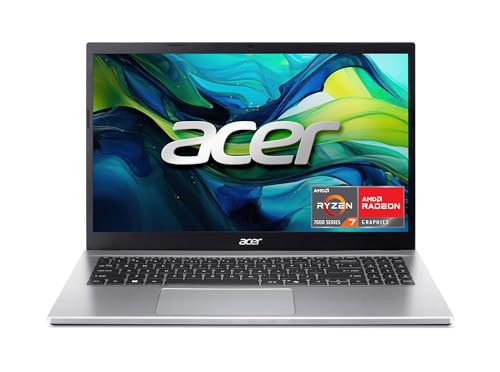
The Acer Aspire Go 15 is an accessible AI-ready laptop with AMD Ryzen 7 7730U and 16GB DDR4 RAM. It offers solid single-thread performance and good integrated graphics for visualization and light model runs. The 512GB PCIe Gen4 SSD speeds up dataset access and model load times compared to older SSDs.
I used the Acer for rapid prototyping, small dataset training, and web deployment testing. It’s light on budget but balanced in specs for developers who need decent performance without breaking the bank. For those starting out in AI development or needing a reliable secondary machine, the Acer Aspire Go 15 is a practical pick.
Pros:
- Good price-to-performance ratio for entry-level AI tasks.
- Ryzen 7 provides solid single-thread speed for model code and data ops.
- 512GB PCIe Gen4 SSD reduces I/O bottlenecks during dataset loads.
- Portable 15.6″ form factor fits everyday carry and travel.
- Wi-Fi 6 gives fast downloads and cloud sync for datasets.
Cons:
- Integrated Radeon graphics are limited for heavy GPU training.
- 16GB DDR4 is fine but less future-proof than DDR5 for massive multitasking.
- Not ideal for big local pretraining or large batch sizes.
My Recommendation
I recommend the Acer Aspire Go 15 to beginners and budget-minded developers. It’s a good way to run interactive notebooks, prepare datasets, and deploy small models. If you need the best laptop for AI development on a budget, the Acer gives realistic performance for learning and prototyping without extra cost.
| Best for | Why |
|---|---|
| Budget developers | Balanced specs at a lower price for learning and prototyping. |
| Portable dev kits | Light and compact for travel and demos. |
| Small model training | Good CPU/GPU mix for lightweight experiments. |
FAQs Of best laptop for ai development
What specs matter most for the best laptop for AI development?
CPU cores, RAM size, SSD speed, and GPU matter most. I look for high core counts for preprocessing, at least 32GB RAM for real workloads, and a fast NVMe SSD. A discrete GPU helps for local deep learning. Ports like Thunderbolt are useful for external accelerators.
Do I need a dedicated GPU to start AI development?
No. You can start with CPU and integrated graphics for learning, prototyping, and small models. But for larger models and faster training loops, a dedicated GPU or cloud GPU is recommended. I often use a local GPU for experiments and cloud for heavy training.
How much RAM is enough for AI work?
For hobby projects, 16GB can work. For real development, I recommend 32GB minimum. For large datasets or multi-container workflows, 64GB or more is ideal. RAM reduces swapping and keeps data ready in memory, speeding iterations.
Is cloud training better than local training on a laptop?
Yes and no. Cloud training gives scalable GPU power and is cost-effective for big jobs. Local laptops are great for iteration, debugging, and small experiments. I use a mix: local laptops for quick cycles and cloud for heavy training and final runs.
Which ports should a laptop have for AI work?
Thunderbolt/USB4, USB-C with PD, and at least one USB-A are useful. An SD slot, HDMI/DisplayPort, and 2.5GbE or Wi-Fi 6/7 also help. I value Thunderbolt for fast external drives and eGPUs when needed.
Final Verdict: Which Should You Buy?
Choosing the best laptop for AI development depends on your workflow. For heavy local work and future expandability, I favor the Dell 16 Plus or Lenovo ThinkBook 16 Gen 8 for their balance of CPU, RAM, and I/O. They give reliable speed for development and prototype training.
If you’re on a budget or just learning, the Acer Aspire Go 15 or HP 17 (i3) are practical starters. For touchscreen and more power without stepping up to desktop-class rigs, the HP 17 Touch is a solid midrange option. Each of these can be the best laptop for AI development depending on your needs.



